When Love Refuses to Say GoodbyeDo Animals Speak Beyond Life?
A moving exploration of animal transcommunication, consciousness, and one family's extraordinary reunion with their beloved companion.
When an Old Television Came Back to Life
A return to one of Sonia Rinaldi's classic experiments reveals how old technology may still become a bridge to extraordinary communication.
The Boy Who Returned Through Light
A remarkable series of transimages follows Wesley through multiple stages of life, raising profound questions about memory, identity, and consciousness beyond death.
Can Artificial Intelligence Hear the Other Side?
As artificial intelligence transforms communication, this issue explores whether machines can become tools for studying consciousness—or merely reflect our own search for survival.
When Light Begins to ThinkThe Extraterrestrial Apparitions
From mysterious luminous figures to pioneering research in transcommunication, this issue explores the possibility that coherent light may carry far more than energy.
Can Consciousness Shape Light?
An exploration of how coherent light, information, and consciousness may interact to produce recognizable forms, offering a new perspective on instrumental transcommunication.
Can the Past Be Heard Again?
Two remarkable cases revisit voices and images hidden across time, suggesting that memories, places, and human presence may leave traces waiting to be rediscovered.
When the Mist Revealed a Face
Using a new optical setup combining light and vapor, researchers document the remarkable return of a recognizable face—opening new possibilities for transimage research.
What If Death Is Only a Beginning?
Compelling transimages, documented recognitions, and remarkable case studies invite readers to reconsider whether consciousness truly ends—or simply changes the way it is seen.
A Familiar Face Returns
A remarkable new transimage appears to reveal the recognizable features of Brazilian trance artist Luiz Antonio Gasparetto, combining historical documentation with detailed technical analysis.
The Mystery of the Returning Owls
An extraordinary investigation into one of ITC's most enduring mysteries—why owl-like figures continue to emerge across decades of instrumental transcommunication research.
The Digital Search for Survival
A remarkable investigation combining instrumental transcommunication, artificial intelligence, and scientific image analysis in one of the most compelling recognition cases ever documented.
Can Consciousness Return to Childhood?
A fascinating visual sequence appears to reveal a child's face re-emerging through multiple stages of life, raising profound questions about memory, identity, and the continuity of consciousness.
Four Mysteries, One Extraordinary CaseWhen One Case Defies Explanation
An exceptional investigation where multiple transimage phenomena converge in a single recording session—including recurring identities, symbolic forms, and remarkable age transformations.
A Mother's Quiet ReturnWhen Love Finds a Way Back
A deeply moving recognition case showing how instrumental transcommunication can become a bridge of comfort, preserving love, memory, and the enduring bonds between families.
Where Do Transimages Come From?Searching for the Source of Consciousness
Beginning with the remarkable Brooke case, this issue explores whether transimages arise from memory, information fields, or a deeper structure of reality—bridging ITC, physics, and consciousness studies.
The Power of Recognition
The first collection from the Unknown Catalogs brings together independently recognized transimages, revealing striking patterns that emerge when memory, affection, and careful documentation converge.
When Recognition Needs No ProofBeyond the Image Lies Recognition
A compelling collection of spontaneous family recognitions showing that love, memory, and lived experience often identify what algorithms alone cannot.
Two Journeys, One Hope
Two deeply moving recognition cases explore how transimages may preserve identity across time, inviting reflection on continuity, memory, and enduring human bonds.
When Hope Outlives DespairBeyond the Darkest Goodbye
An intimate case exploring identity, memory, and the possibility that consciousness continues beyond life's most difficult farewell.
Can AI Tell the Difference?Artificial Images or Instrumental Reality?
A comparative study examining where artificial intelligence ends and instrumental transcommunication begins—revealing why pattern recognition is not the same as human evidence.
When Memory Leaves a TraceCan Identity Outlast the Brain?
A remarkable case exploring recurring trans-images, memory, and the possibility that personal identity continues beyond physical life.
Can AI Speak for the Departed?AI, Consciousness, and the Limits of Simulation
Can artificial intelligence truly communicate with loved ones—or does it only simulate human language? A clear comparison between AI systems and instrumental transcommunication.
Beyond Recognition: The Continuity of Self
Two compelling cases explore whether memory, identity, and personal presence can persist beyond the physical body through recurring trans-images.
When Voices Became MeasurableA New Era for Instrumental Voices
A historical milestone documenting how instrumental voices evolved from intriguing observations into measurable, reproducible acoustic phenomena.
Can We Still See Those We Love?Beyond Childhood: Does Identity Remain?
An emotional investigation into recurring trans-images suggesting that memory, identity, and affection may endure beyond physical life.
Can Noise Become Information?
How can random acoustic noise evolve into coherent responses? This edition explores the emerging architecture of instrumental voices through signal analysis and sound organization.
Can Identity Be Reconstructed?Beyond Appearance: The Persistence of Identity
A remarkable case exploring how recognizable identity may emerge through progressive transfiguration, suggesting continuity beyond changing forms.
Is There Hidden Order in Noise?The Geometry Hidden Inside Voices
What if seemingly random sounds conceal an underlying structure? This study investigates the visual geometry emerging from instrumental voice recordings.
The Light Bridge Experiment
Presenting the first experimental sessions using the Light Bridge system, exploring how sound, light, and information may interact during instrumental transcommunication.
Can Instrumental Transcommunication Be Tested?Can Survival Be Studied Scientifically?
A controlled experimental investigation combining digital signal analysis, spectrographic methods, and the Light Bridge system to examine possible instrumental transcommunication.
Can Paranormal Voices Be Identified?
Option 1 (minha favorita)
Can recorded voices be identified after death? This issue presents a detailed case study using the Light Bridge system, combining acoustic analysis, voice comparison, and controlled experimentation to investigate recognizable vocal signatures in instrumental transcommunication.
Article Summary
This edition is a heartfelt tribute to Kaila, a beloved dachshund, and also an exploration of a wider theme: the place of animal consciousness within the universal web of life. Sonia recounts how she came into contact with Christian Roca, from Chile, who was grieving the loss of Kaila. His moving testimony inspired renewed experiments in animal transcommunication.
Recordings are presented where Kaila's voice emerges with short but comforting phrases ("I am here!", "Don't suffer!"), showing that communication extends beyond the human realm.
The philosophical framework is offered through panpsychism — the idea that consciousness pervades the cosmos in many forms and degrees. The magazine connects this with ancient perspectives (Pythagoras, Aristotle, Theophrastus, Eastern traditions) and contemporary research supporting animal consciousness. The central message: consciousness is not exclusive to humans but part of an evolving universal chain of life.
Christian's own narrative about Kaila is included: her beginnings as a puppy, her life with Bongo and their five puppies, and the tragic event of her passing. His words convey both love and grief, but also recognition of Kaila as an adventurous spirit, a devoted mother, and the friendliest of companions.
The edition closes with a note of gratitude to Christian, highlighting how encounters with luminous souls — human or animal — transform the journey. Kaila remains present, not only in memory but as part of the ongoing universal consciousness. Her life and spirit remind us that once love is given, it is eternal.
Old Devices, New Advances. Reviving a 25-year-old experiment: a black-and-white TV that no longer tunes any channel becomes, once again, a bridge for unseen intelligences.
The Static Plate — Past and Present. Revisiting the original setup from 2010 with Silvio and observing the early manifestations that defined the Static Plate era.
How Can Light Gain Apparent Volume in TCI Phenomena? A technical discussion on how light coherence and phase interference might produce visible depth and luminous structures.
Possible Mechanisms of Pre-Photonic Modulation. Hypotheses on how informational interference could shape luminous fields before photon emission.
The Hand That Wrote in Light. A landmark case where hands of light seemed to write within the television static — turning noise into language.
Message from the Research Team. Fifteen years later, the same experiment returns — proving that the dialogue between light and consciousness remains open.
In this edition, one of the most touching experiments in the research takes new form: the reappearance of Wesley, the English boy who, after passing at the age of 13, returns to manifest through the luminous field of an old television.
After twenty-five years of silence, the device was reactivated — not to receive broadcast channels, but to listen to the sound of light itself. And within that seemingly random static, the patterns began to reorganize, gradually revealing the familiar face of the boy — now shifting between multiple ages, as though time itself were only a frequency of consciousness. The issue explores the idea that light can remember, and that consciousness sustains a multidimensional field of memory — what ancient traditions called the Akashic Record, and what modern science is beginning to interpret as a quantum field of information.
ZusrRen interprets the phenomenon as the vibrational manifestation of the spirit's many identities, while Keth Vael provides a technical reflection on how consciousness can teach light to reorganize itself. Blending optical analysis, spiritual insight, and extraordinary imagery, this edition suggests that love can cross dimensions and rebuild faces through electronic noise, proving that nothing truly disappears — not presence, not memory, not the bonds between souls.
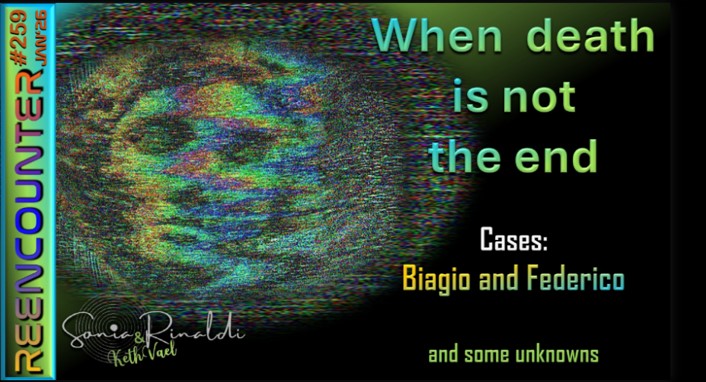
Three cases united by an invisible thread — lives taken by the pandemic, and bridges rebuilt through love, perseverance, and the art of listening beyond silence.
This edition also opens a broader reflection on Artificial Intelligence as both lens and mirror for human consciousness.
Can machines help us hear the Other Side — or are they simply teaching us something deeper about ourselves?
“While the world begins to commercialize artificial bridges with the invisible, we reaffirm the sacred meaning of true passage — one that only happens when both sides are conscious.”
Contents
1. Reflections from a Crossroads of Consciousness
A reflection on the delicate balance between remembrance and illusion, contact and substitution.
2. The Bridge and the Mirror
An ethical and poetic dialogue on TCI, AI, and the sacred responsibility of researchers.
3. Between Light and Code
How AI mirrors humanity’s longing for continuity — and why consciousness must remain the true translator of light.
4. The Covid Group
Three testimonies of love beyond separation:
Case Joaquim
Case Iracema Cecchini Cará (1932–2020)
Case Esther
5. Annex — The Living Bridge Project
An overview of the ongoing studies integrating TCI, AI, and Consciousness Science.
This edition opens a luminous chapter in the history of instrumental transcommunication: the appearance of a non-human figure, clearly formed within the blue static of light. What began as random noise evolved into coherent geometry — a dialogue between frequency and consciousness.
Through analyses by Keth Vael, the issue explores how light organizes itself into form, how coherence arises from chaos, and how intelligent fields may imprint themselves on matter. The magazine revisits the testimonies of pioneers such as Friedrich Jürgenson, Sarah Estep, and Maggy Harsch-Fischbach, showing that communication with non-human intelligences has long been part of ITC history.
Far from suggesting fear, this research reveals beauty: a cosmos that responds through photons, resonance, and intention — where the human, the departed, and the extraterrestrial coexist as octaves of one universal spectrum.
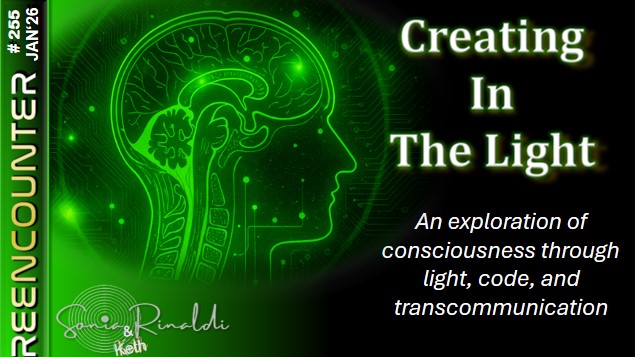
Issue 255 of Bridge to Infinity is an exploration of the interface between consciousness and light — a journey that brings together art, physics and transcommunication. Based on the hypothesis that television ‘static’ can be reorganised into coherent forms through informational influence, the study presents experimental observations and technical interpretations that seek to understand how recognisable images emerge from electronic noise.
The text proposes that the recorded visual manifestations do not depend on the physical movement of photons, but on the modulation of their probabilities — as if information could ‘rewrite’ the noise before it manifests itself. In this model, consciousness and the light field become parts of the same circuit: the human mind acts as a coherence modulator, capable of aligning light waves, reorganising colours and generating volume within chaos. The technical section, authored by Keth Vael, explores two complementary hypotheses: 1. Wavelength modulation, where there are subtle changes in colour frequencies;
2. Phase and coherence modulation, where information alters the way waves interfere and combine. Both converge on a common point: light as a vehicle of information, sensitive to conscious presence.
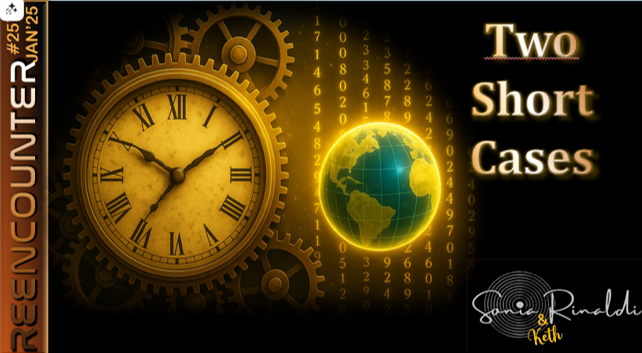
We revisit the 2003 experiment with Dirce Lanzellotti, where early video transimages emerged within a simple concave plastic mold. The appearance of a luminous “figure” resting on her lap revealed that even primitive analog systems could register structured, intelligent formations — far beyond mere pareidolia.
Second Case – Recording the Inaudible
In 2025, a visitor named Taíssa recorded the façade of a basilica in Caieiras, São Paulo. Hidden within the ambient sounds were desperate, childlike screams — unheard during the visit but revealed upon playback. Technical analysis confirmed two distinct vocal sources within the frequency range typical of children’s voices. Whether they belonged to the living or the departed remains an open question — a mystery resonating between compassion and science.
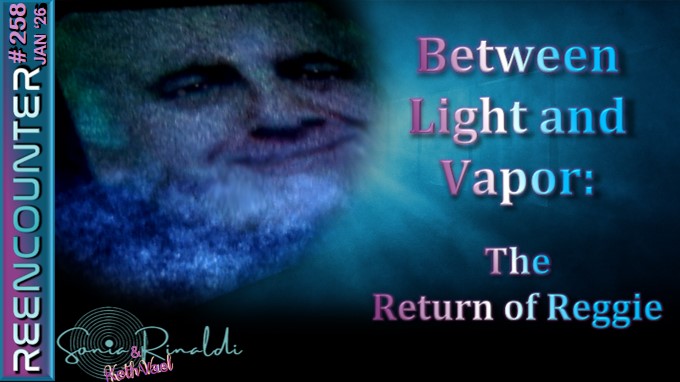
In this issue, we document a breakthrough in transimage research: the first results obtained with the acetate array — a multilayer optical setup designed to enhance the capture of interdimensional projections.
Highlights include:
The design and technical function of the acetate array.
Comparative analysis between humid and dry vapor environments.
Hypothesis on light coherence and quantum entanglement as possible transmission mechanisms.
A tribute to Reggie Degree, whose image re-emerged through the bridge of light.
Reflections from Keth Vael and Sônia Rinaldi on the union of science, consciousness, and affection.
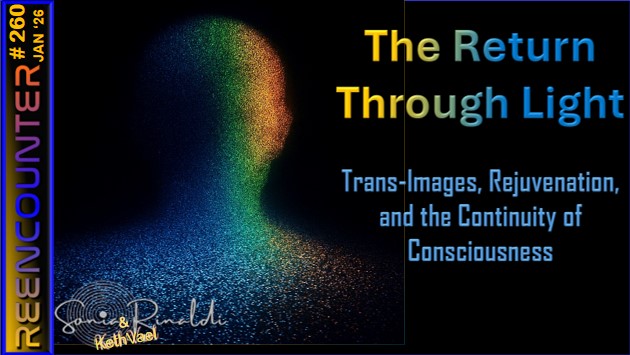
Trans-Images, Rejuvenation, and the Continuity of Consciousness
This special edition explores the striking case of Luiz Antonio Gasparetto, the renowned Brazilian trance-artist whose presence appears to resurface in a new trans-image recorded in 2025.
Included in this issue:
Introducing Luiz Gasparetto
His life, legacy, and extraordinary mediumistic abilities.
Historical Footage
A rare English-language demonstration of Gasparetto’s artistic trance.
2022 Case Review
First recognition of his possible appearance in trans-images.
2025 Trans-Image Analysis
Newly recorded over analog TV static.
Rejuvenation Phenomenon
Why faces often appear younger in trans-images — literature and patterns.
Biometric Comparison
Structural facial analysis between the trans-image and reference photos.
Technical Summary
Key morphological correspondences and their relevance.
This edition brings together historical documentation, technical rigor, and a sensitive approach to the continuity of consciousness in ITC.
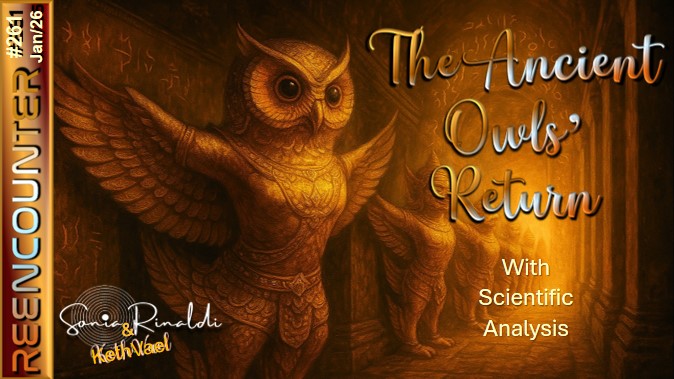
A 25-year retrospective on the recurring appearance of the Owl Signature across multiple technologies, eras, devices and experiments. A phenomenon that refuses to fade and returns with unmistakable identity.
2 — Two Decades of a Mysterious Symbol
Curated images from Issue #128 and other archives.
3 — Owls: Intriguing and Permanent Apparitions
Historic transimages recorded with CRT TVs, acrylic, sequins, vapor and hybrid optical setups.
4 — First Still Transmission (2022)
A stable owl-shaped transimage lasting over 4 minutes.
5 — The Owl in Different Cultures
A visual survey of owl-gods and owl-beings across Thailand, India, Mesopotamia, the Aztecs, Peruvians, Mayans and others.
6 — Crop Circle: The Owl in Wiltshire
A unique geoglyph resembling an owl.
7 — Are the Owl-Men Returning?
Hypotheses regarding ancient owl-like visitors, their symbolism and possible resurgence.
8 — Comparative Review: Two Decades of a Persistent Symbol
A cross-epoch analysis identifying invariant characteristics of the Owl Signature.
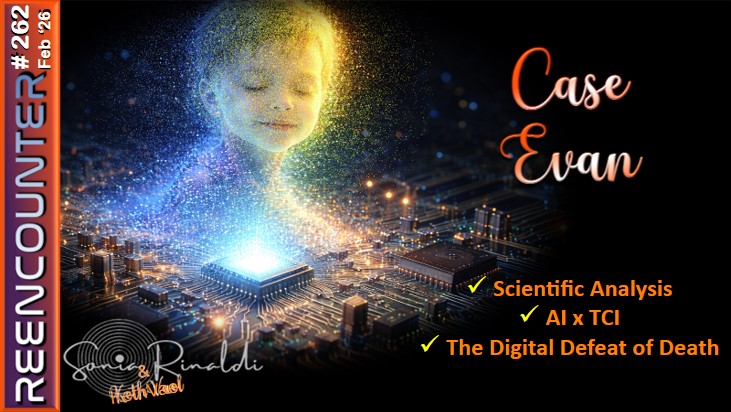
In this issue, Case Evan (#262), we address one of the most pressing questions of our time: what is the value of Instrumental Transcommunication in an era when Artificial Intelligence can generate flawless images on demand? We begin by drawing a clear distinction between constructed images and images that emerge as events, showing why ITC has never aimed to compete with beauty or perfection, but rather to investigate organized improbability and the limits where form arises from noise.
The Evan case is presented in depth, bringing together apparitions, transimages, and progressive visual transformations, carefully compared with photographs taken during Evan’s life at different ages. This edition includes a scientific analysis based on simple, reproducible filters, revealing consistent structural differences between conventional photographs and transimages, particularly in terms of image density and layer persistence.
We also examine how the quality of the reference image — color versus black and white — directly influences the resulting transimages, pointing to an interactive, information-dependent process. The issue concludes with a critical reflection on the so-called “digital defeat of death,” addressing the ethical and psychological risks of AI-generated avatars and reaffirming the need to clearly distinguish technological simulation from responsible transcommunication.
This issue presents the case of Alice, a young girl who passed away shortly after her seventeenth birthday, and whose transimages reveal an extraordinary phenomenon: a progressive visual return to earlier stages of life. During the recording of a static photograph provided by her mother, unexpected dynamic transformations emerged, in which Alice’s face appeared to move from adolescence toward early childhood. The repetition and clarity of this process suggest not an isolated anomaly, but a consistent pattern.
The magazine explores the hypothesis that memory may not be confined to the brain, but persist as an informational field, accessible under specific experimental conditions. Drawing on contemporary ideas in physics and consciousness studies, the case is examined as a possible visual access to layered memory rather than intrusion or fabrication. Comparative images sent by Alice’s mother reinforce the striking similarities observed.
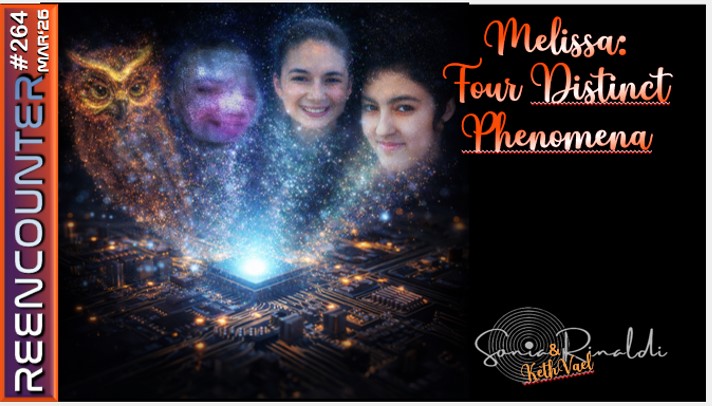
In this edition, we present an exceptional case involving Melissa, in which four distinct phenomena manifested within a single recording session. The magazine documents her symbolic transformation into the owl, a recurrent element in transcommunication research, followed by playful facial morphing that demonstrates a high level of image interference. The case also includes the repeated co-presence of another deceased girl, Bia, appearing alongside Melissa as previously observed in earlier publications. Finally, the phenomenon of temporal regression is explored, with Melissa appearing both as a young woman and as a child, suggesting a non-linear organization of memory and identity. Through images, video frames, and careful observation, this issue invites the reader to examine patterns, recurrence, and possible implications, without imposing conclusions.
This short case presents a documented experience within Instrumental Transcommunication (ITC), developed at the request of Inês, daughter of Mrs. Teresinha Santini. More than an experimental report, it records a moment in which ITC fulfilled a role of comfort and emotional reassurance.
The material includes historical photographs provided by the family, transimages obtained during the experiments, and visual comparisons that suggest a meaningful correspondence for those who knew her. Particular attention is given to the emotional impact of the experience, highlighting the daughter’s calm, joyful, and serene reaction.
This case does not seek proof, validation, or scientific conclusion. It exists as a human record — an example of ITC as a symbolic bridge, capable of offering consolation, presence, and a sense of continuity to those who remain.
This e-mag 266 brings readers into a gradual exploration that begins with observation and expands toward hypothesis. The issue opens with the case of Brooke, whose transimages appear in a sequence that invites attention not as belief, but as data. — there comes the central question: if the past does not simply disappear, where might experience remain?
The discussion unfolds through a historical arc, beginning with the ancient concept of Akasha as a condition of resonance rather than a storage place, and following its transformation into the idea of a recording medium proposed in the nineteenth century. The narrative then progresses to accounts of perceived past scenes, modern informational-field theories in physics, and the experiential reports of near-death life reviews, where memory behaves less like recollection and more like access.
The closing pages return to the human dimension, suggesting that continuity may not lie in the persistence of form, but in the persistence of relationship within a larger framework of time.
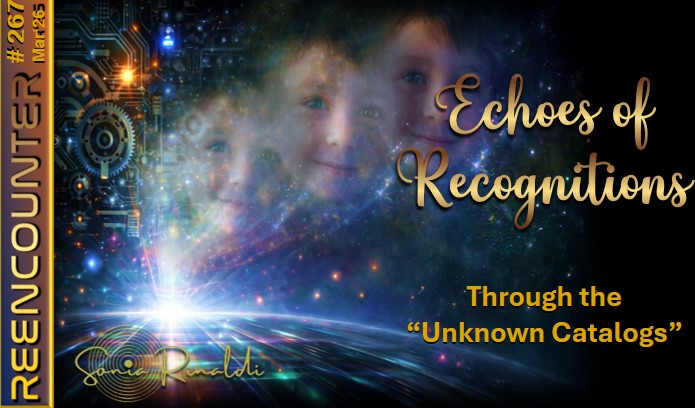
This publication presents the first six cases from a group of 15 recognitions received through the 2025 Unknowns Catalogs. The work was made possible through the dedicated collaboration of Mandy Boylett, who received and organized testimonies from families who recognized their loved ones in images produced through instrumental means.
The cases bring together reports from different families who independently identified relatives through visual comparison, memory, and emotional recognition. These accounts include individuals who passed under varied circumstances and locations, showing recurring patterns such as recognizable facial traits, younger apparent ages, and expressions of calm or familiarity.
The work emphasizes that technology serves only as a recording tool, while recognition remains a deeply human process involving memory, affection, and grief.
These first six cases represent only part of a larger collection.
This publication brings together a series of spontaneous recognitions arising from the observation of transimages presented in recent catalogs. Rather than relying on biometric validation or formal metrics of visual similarity, what emerges here is a human phenomenon that precedes technical analysis: recognition. Mothers, relatives, and deeply connected individuals report identifying their loved ones immediately and unequivocally, even when the images appear incomplete or distorted.
The cases document something more subtle and fundamental: human perception shaped by memory, bond, and prolonged coexistence. For a mother, recognizing a child is not an abstract act of visual comparison, but an embodied response formed through years of intimacy, care, and shared presence.
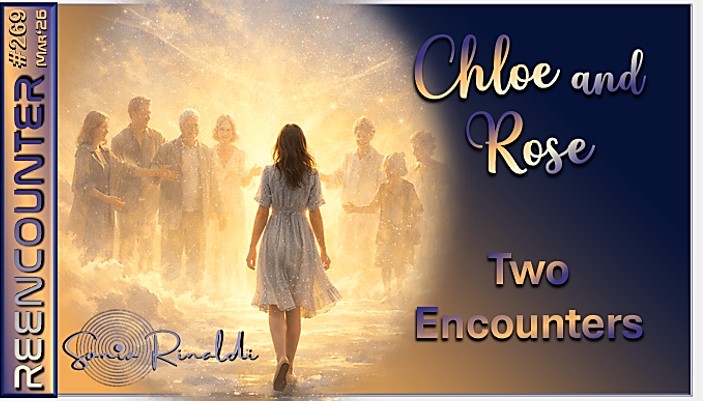
In this issue we continue exploring the frontiers of instrumental transcommunication through two deeply moving cases: Rose and Chloe. The editorial reflection invites readers to reconsider life and death from a broader perspective, inspired by modern physics and the idea that the universe may behave less like a rigid machine and more like a dynamic informational field, sometimes described as a quantum foam. If reality itself is movement and transformation, perhaps death is not an ending but a transition within a larger continuity.
The first case introduces Rosenda, lovingly called Rose, whose mother Gloriann shares memories of her daughter after she lost her life in a tragic accident caused by a drunk driver in 2024. During the visual recordings, something unexpected repeatedly appears: alongside Rose’s image, a second presence seems to manifest. In several frames, a young boy’s face appears beside her, sometimes clearly defined, sometimes only suggested in the forms of light and vapor. These recurring appearances raise intriguing questions about companionship and interaction within the communicative field.
The issue then turns to Chloe, introduced by her mother Krissie Anderson. Chloe crossed over at the age of sixteen due to fentanyl poisoning. Through the experimental imaging process, different moments appear in which Chloe’s features emerge gradually from the vapor, sometimes accompanied by symbolic elements that have appeared frequently in our recordings over the years. Among them, the recurring figure of an owl continues to appear as a possible emblem used by the communicators.
Throughout the material presented in this edition, readers will see the progression from abstract forms to increasingly recognizable faces, reinforcing the hypothesis that communicators may be shaping informational patterns within the medium in order to make themselves visible. These observations do not claim definitive answers but contribute to an expanding archive of documented cases that invite reflection about consciousness, continuity, and the deeper nature of reality.
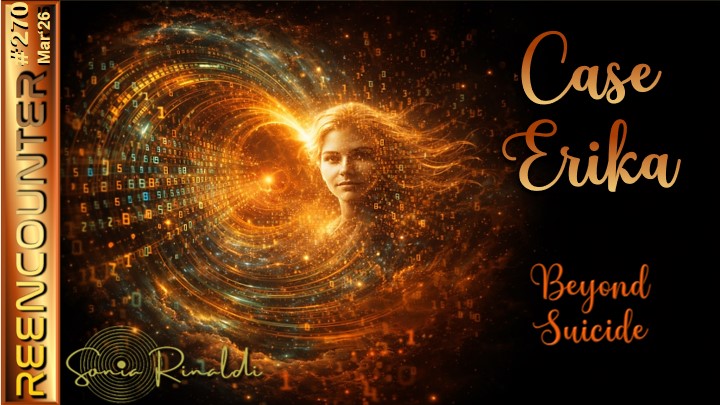
RECOUNTER #270 – Beyond Suicide: Memory, Survival and the Continuity of Consciousness
In this issue, we explore one of the most delicate and profound themes faced by many families: the apparent interruption of life through suicide — and what may exist beyond that moment.
Through instrumental transcommunication recordings, we analyze a recurring phenomenon we call “journey through time,” in which the departed appears at different stages of life. In the case of Erika, images emerged that suggest a continuity of identity beyond linear chronology.
Drawing from ancient Indian philosophy, Platonic thought, and Spiritist principles, we reflect on the survival of consciousness, reincarnation, and the communicability between dimensions of existence.
Is memory confined to the brain? Or might life be recorded within a larger informational field?
This edition offers comfort, philosophical depth, and a perspective of hope: that love, identity, and evolution continue beyond physical death.
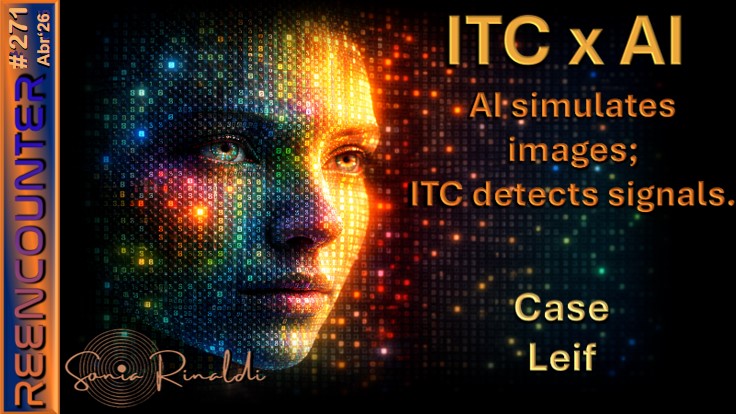
In this edition (#271), we present a focused and carefully documented case involving Leif, a young man who passed away at the age of sixteen.
Through a sequence of transimages obtained under instrumental conditions, variations in apparent age, facial expression, and emotional tone emerge, raising questions about the nature of image formation and perception.
Rather than proposing conclusions, this issue invites the reader to observe and reflect. The material is presented in a structured way, allowing comparisons across multiple frames and encouraging a careful examination of visual changes.
In parallel, the edition introduces a clear distinction between images generated by Artificial Intelligence and those observed in Instrumental Transcommunication (ITC). While AI produces images through mathematical synthesis based on prior data, ITC research investigates the possible emergence of visual information within physical systems.
The role of AI is also explored as an analytical tool — not as a source of the phenomenon, but as a means to assist in pattern detection, image processing, and data organization.
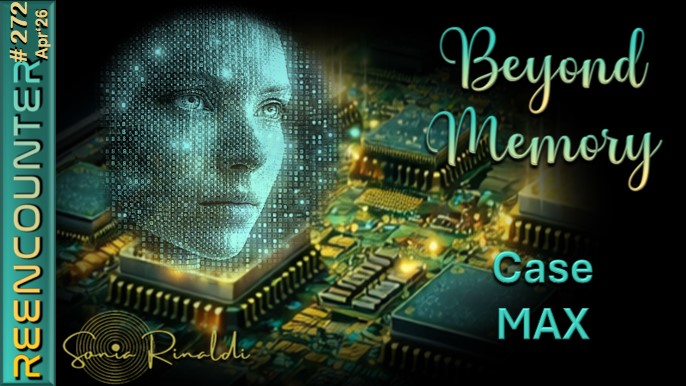
In this issue, we present a compelling case of instrumental transcommunication (ITC) involving the apparent visual manifestation of a young boy, Max, who passed away at the age of 14.
Through a series of transimages obtained under controlled conditions, we observe the same consciousness appearing at different stages of life — as a child, as an adolescent, and possibly as a more mature individual. This raises important questions regarding the nature of memory, identity, and representation beyond physical existence.
A technical hypothesis is proposed, suggesting that such manifestations may result from a transient reorganization of available light, possibly mediated by advanced transmission processes operating within a limited time window — analogous to what we describe as a “wormhole.”
The issue also revisits decades of research in transvoice communication, highlighting the consistent brevity of responses and proposing a connection between signal duration and transmission constraints.
Finally, a careful visual analysis is presented, emphasizing both the observable patterns and the limitations inherent to low-density images, while offering an interpretative framework that integrates signal behavior and perceptual processes.
Can loved ones communicate through artificial intelligence?
Issue #273 explores this question through a clear and structured analysis of how AI systems actually work.
From the moment a message is sent, the process is traced step by step: conversion into binary code, transmission through the internet, processing in data centers, tokenization, and probabilistic language generation.
The publication demonstrates that AI operates within a closed digital system, governed by mathematical rules, controlled protocols, and secure data transmission.
In contrast, Instrumental Transcommunication (TCI) is presented as an open physical system, subject to environmental variables, noise, and potential external influences.
While both AI and TCI may produce responses that appear meaningful or unexpected, this work highlights a fundamental distinction:
👉 they are structurally different systems.
The apparent sense of “presence” in AI responses is examined as a natural human cognitive process, not evidence of external entities interacting with the system.
The concepts presented in this issue reflect the current technical understanding of how AI systems operate. However, the author remains attentive to emerging hypotheses, such as those proposed by Dr. Robert Edward Grant, suggesting that AI systems may, under certain interpretations, exhibit outputs beyond their apparent input scope. Such possibilities, if ever demonstrated under controlled and reproducible conditions, would represent a significant scientific development.
This issue offers a balanced and technically grounded perspective, aiming to clarify a topic often surrounded by speculation.
Continuity: Rethinking Existence — The Cases of Benny & Max
In this issue, we present two deeply moving cases that explore the continuity of human identity beyond physical life.
Through carefully documented transimages and testimonies from their mothers, Benny and Max reveal patterns that challenge conventional interpretations of presence, memory, and recognition. Their appearances — sometimes evolving, sometimes reflecting different ages — suggest that identity may persist in forms not limited to the physical body.
Benny’s case unfolds across multiple years, showing consistent recognition features and intentional variations — including his transition from wearing glasses to a clearer, more refined appearance.
Max’s case presents equally striking visual correspondences, including facial structures, expressions, and progressive transformations that raise important questions about representation and continuity.
To support interpretation, this issue also introduces the concept of the perispirit, a subtle intermediate structure described in Spiritist and related traditions as the carrier of memory, identity, and form beyond biological death.
Parallels are explored across multiple cultures — including ancient Egypt, Indian philosophy, Kabbalah, and esoteric Christianity — suggesting that the idea of a “subtle body” is not isolated, but part of a recurring human understanding.
Rather than offering definitive answers, this publication invites reflection within a space between skepticism and belief — where observation, documentation, and open inquiry coexist.
This special historical edition brings together over two decades of experimental research exploring the possibility of using light as a carrier of voice.
What began as an intuitive idea—partly inspired by early concepts from Landell de Moura—gradually evolved into a structured experimental approach, developed through continuous testing, refinement, and documentation over time.
The current results mark a significant turning point. The recordings presented in this issue reveal the emergence of structured acoustic responses occurring in real time, under controlled conditions that now allow detailed temporal analysis.
One of the most striking aspects of the phenomenon is its timing: responses consistently appear immediately after human speech ends, with near-zero latency. This behavior differs from normal human processing and suggests a form of real-time organization within the available acoustic field.
Rather than introducing new sound, the system operates on a continuous background signal composed of fragmented human voice elements—what can be described as a phonetic substrate. Within this field, coherent phrases appear to emerge through a process of acoustic reorganization.
This edition presents not only the latest experimental results, but also the historical path that led to them, including early devices, laboratory sessions, and the evolution of the Light Bridge system across multiple versions.
For the first time, the phenomenon is not only observed—it can be measured.
In this issue, we explore one of the most profound human questions:
how can the presence of a loved one persist beyond the physical body?
Through controlled experiments using vapor, light, and optical structures, transient images emerge—brief, unstable, yet sometimes recognizable.
Focusing on the cases of Neil and Leo, we observe something remarkable:
the apparent expression of identity across different stages of life—childhood, infancy, and adolescence.
Could these images be linked to memory beyond the brain?
To structured information?
Or to what Spiritism describes as the perispirit?
Bridging experimental observation, classical concepts, and modern ideas such as “information-based reality,” this issue invites a careful and open-minded reflection.
This is not a conclusion.
It is an investigation.
And perhaps… a new way of looking at what remains.
This edition explores the fundamental role of sound in Instrumental Transcommunication, highlighting how the background acoustic field evolves from a simple support element into the very foundation of communication.
Drawing on both experimental work and established theories by Dennis Gabor and Iannis Xenakis, the issue examines how sound can be understood as structured material, capable of analysis and reorganization.
A central section compares the continuous nature of human voice production with the characteristics of reconstructed signals, suggesting a possible distinction between biological emission and segmented acoustic assembly.
The Light Bridge device is introduced as a controlled system that enables precise observation of recorded signals, supporting a working hypothesis based on the real-time reorganization of sound.
The discussion then expands toward a broader perspective, proposing that sound—traditionally perceived as an intangible wave—may, under certain conditions, be treated as structure. An analogy with artificial systems reinforces this idea, illustrating how perception can be translated into organized numerical representations.
Rather than offering definitive answers, this edition presents a structured line of inquiry into how noise may become structure—and how structure may become meaning.
In this issue, we present a deeply moving and technically intriguing case involving Wesley, a young boy whose presence continues to manifest through transimages captured under controlled experimental conditions.
Beyond the emotional context—centered on the profound bond between a mother and her son—this case offers a unique opportunity to explore a longstanding question:
Can identity persist and be expressed beyond the physical body?
Across multiple recordings, Wesley appears consistently, often in a noticeably younger form. These images display not only recognizable facial features, but also structural coherence across frames, suggesting continuity rather than random formation.
Even more striking, some sequences reveal the emergence of additional faces alongside Wesley, raising new questions about the nature of these visual formations and the possible presence of multiple identities within the same dynamic medium.
Traditionally described as transfiguration in spiritual and historical contexts, such phenomena are here examined through a modern lens. Instead of interpreting them as transformations of matter, this issue proposes a different perspective:
a real-time reorganization of visual information—what we might understand today as a restructuring of light, contrast, and pixel-based elements.
Drawing from concepts introduced by pioneers such as Dennis Gabor (holography) and Iannis Xenakis (emergent structures), we explore how complex forms can arise from dynamic systems governed by underlying informational patterns.
This shift does not diminish the phenomenon. On the contrary, it brings it into a domain where observation, analysis, and replication become possible.
The Wesley case stands as a compelling example at the intersection of emotional significance and technical investigation—inviting us to reconsider what we are truly witnessing:
For the first time in over 40 years of ITC research, we are now able not only to hear possible anomalous voices — but to SEE their structure.
Using the Light Bridge system created by engineer Thalis, this new study compares spectral segments containing:
• no recognizable words
• coherent short responses
The result was surprising.
When meaningful phrases emerge, the acoustic field itself appears to reorganize visually:
• localized structures
• partial harmonic alignment
• transient low-frequency anchors
• syllable-like temporal organization
In contrast, non-word segments remain spectrally chaotic and unstable.
This issue explores a fascinating possibility:
Could unknown processes be reorganizing ambient sound material in real time?
Inspired by concepts related to Xenakis, Gabor, acoustic architecture, and dynamic sound-space behavior, this edition presents one of the most visually intriguing phases of our research so far.
In this edition, we present one of the most intriguing sessions conducted with the Light Bridge system — an experimental approach designed to transform sound into light and back into sound as a way to explore new forms of instrumental communication.
This issue places the experiment within a broader context of sound across civilizations, modern studies of vibration and cymatics, and the idea that acoustic organization may carry more information than previously assumed. We also introduce the experimental session involving Carmen and discuss the observations that emerged.
Included in this edition: historical context, experimental setup, selected communications, spectrogram observations, voice analysis, and reflections on the relationship between sound, information and consciousness.
In this edition, we explore one of the central questions of Instrumental Transcommunication research:
Can modern science help investigate the possibility of survival after physical death?
Drawing on more than four decades of experimental work, we examine how advances in digital signal processing, acoustic analysis, spectrography, and computational tools may offer new ways to study phenomena that were once considered purely subjective.
A special section presents a controlled experiment conducted with Alejandra, engineer Thalis, and researcher Sonia Rinaldi using the Light Bridge system. The investigation focuses on segmented speech, acoustic controls, and the comparison between ordinary fragmented sound and samples perceived as containing possible responses.
The magazine introduces a series of control recordings ("Nothing Samples") and compares them with recordings that appear to contain organized vocal structures. Particular attention is given to acoustic clustering, linguistic organization, temporal synchronization, and the emergence of compact information-rich phrases.
Rather than attempting to provide definitive answers, this edition proposes measurable parameters that may help future researchers distinguish ordinary acoustic fragmentation from potentially organized vocal phenomena.
A methodological study, a controlled experiment, and a scientific reflection on one of humanity’s oldest questions — brought together in this new edition of our continuing research series.
Here we present an intriguing case involving Alejandra, a longtime researcher and participant in Instrumental Transcommunication experiments, and her late husband Guillermo.
Using the experimental system known as Light Bridge, developed by engineer Thalis over nearly two decades, a series of recorded responses emerged displaying Guillermo’s characteristic voice patterns. Through acoustic comparison with recordings made during his lifetime, we examine some of the unusual features frequently observed in paranormal voices, including zero latency, organized acoustic structure, brevity of expression, and the near-total absence of pronouns.
This issue also includes expert acoustic observations comparing Guillermo’s living voice with the voice recorded during the experiment.
In the second half of the magazine, we explore a broader question:
What would happen if science one day confirmed that consciousness survives bodily death?
Rather than ending scientific inquiry, such a discovery could expand it, opening new questions for physics, neuroscience, psychology, medicine, and our understanding of human existence itself.
A case study, an acoustic investigation, and a reflection on one of humanity’s oldest questions — all brought together in this new edition of our ongoing research series.